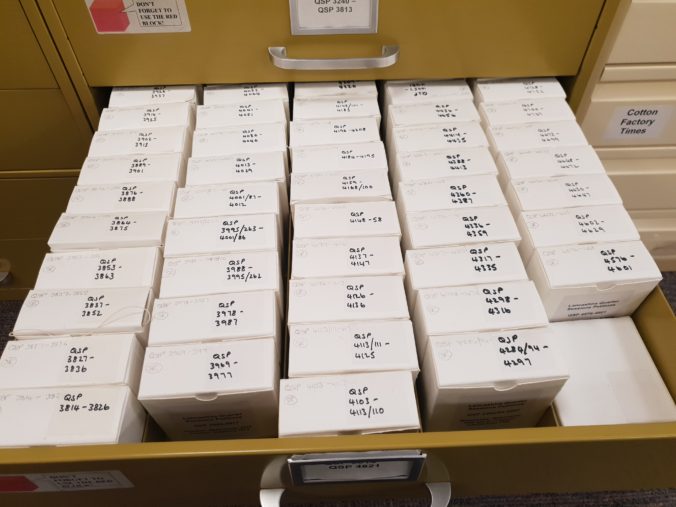
Tracing your family history? Awesome! What you’re doing is a form of archival research. Archival research means you’re looking for information and evidence in archives. What’s an archive? Just a collection created to preserve certain types of objects. For example, a record office is an archive the keeps birth, marriage and death certificates, while a local history centre is an archive that keeps letters, photos, documents and books relating to its town’s history. Even a library is a form of archive – it collects and preserves books.
Most of the research for my book about Mary Ann Britland is archival. I love it – it’s like poking around in your family’s old letters and photos, but you get to feel like a clever clogs while you do it. However, it can become expensive and time-consuming, especially if you have to do it long-distance (which, because I live in Sydney and the information I need is in England, I usually do).
Luckily, there are lots of ways to save your time and cash while still digging up all your juicy family secrets. Check out my pro research tips below.
Heads-up: These tips reflect my experience – i.e.: as a European Australian researching people who lived in England. Unfortunately, they’re less helpful for people researching other histories – especially non-European ones. I wish I had more advice for that, as I know it can be extremely difficult. If you have any tips or links that might help, please leave me a comment and I’ll add them to the bottom of this list (with a credit back to you, of course 😊).
1. Join your local AND your state library
Yes, yes, I’m sure you’ve heard this all before. Your library is an invaluable resource, blah, blah, blah. But, seriously, it is. Librarians are professional archivists and many spend their days searching and maintaining the same databases you’re trying (and, possibly, struggling) to use. Ask them for help! And while you’re at it, ask them what websites and databases you can access through their computers. Many local libraries offer free access to genealogy sites like Ancestry and FindMyPast, which is great if you’re researching on a budget (at twenty bucks a month each, these sites aren’t cheap). Local libraries also often host FREE local history and family research events, which are fantastic for new researchers (or anyone looking to brush up their skills).
Think about joining your state library too. Most Australian state libraries offer free access to academic databases via their websites, which means you can do serious background research in the comfort of your own home (with or without pants). And you can usually sign up online, which is a lifesaver if don’t live near a capital city (or if you’re coveting online content from another state’s library). I’m currently a member of the NSW and QLD state libraries, as well as the Australian National Library. ‘Cause when it comes to library cards, you’ve gotta catch ’em all.

Going to the library is extra fun when it looks like this. John Rylands Library, Manchester.
2. Use Ancestry and FindMyPast
Have you joined all your nearby libraries? Good. Do you have access to Ancestry AND FindMyPast? Great! You’re going to want to use both of them. While Ancestry and FindMyPast do offer many of the same records, there are some that are exclusive to each site. For example, Ancestry has the parish records for Gloucestershire, but FindMyPast has the records for the city of Bristol. And FindMyPast has the parish record transcriptions for Hampshire, while Ancestry has the parish records for Surrey (including some areas of Hampshire that used to fall into Surrey, such as Crondall).
Ancestry and FindMyPast also have different search functions, which means it’s sometimes easier to find what you’re looking for on one site than the other. I find Ancestry is better when I’m less sure what I’m looking for. Its searches cast wide nets, pulling in dozens – sometimes even hundreds – of possible record matches, which is great if you’re not certain that the info you’ve got is correct. It’s also easy to build family trees, plus Ancestry will give you hints on where to look next based on the info you’ve already added. But sometimes it’s a little too easy and the option to pretty much copy and paste other people’s family trees allows incorrect information to spread far and wide. You really need to double-check every record – the scans of the originals (where available), not the transcriptions – and verify as much of the info (names, dates, spouses, children, locations, etc) against what you already know.
FindMyPast doesn’t hold your hand as much, but I find that it’s better for targetted searches. If you’re absolutely confident that you know how one aspect of your search will appear on the record you’re looking for (for example, the spelling of your subject’s name or the year of their birth) and you’re feeling overwhelmed by Ancestry’s endless list of “possible” matches, try a search on FindMyPast. It’ll throw up fewer results, but I find that they’re more likely to be what I’m looking for. FindMyPast also gives you free access to the British Newspaper Archive, which holds more than 30 million (!) pages of British newspaper content from the 18th century to today. If you’re doing a lot of newspaper research, I’d actually recommend subscribing to the proper BNA website as well, as the search portal for the FindMyPast version has limited filtering options. But as far as bonuses go, even partial access to the BNA collection is pretty great.
3. Search individual archives and make notes of your faves
Genealogy websites are great, but the vast majority of records and sources that exist just aren’t on them (simply because there’s so damn many of them). If you really want to learn about your ancestor’s life, you’ll need to go where the records themselves are held – the archives. National archives, like the National Archives of Australia in Canberra and the UK National Archives in Kew, are a great place to start, as their online catalogues allow you to search their collections as well as collections from all over the country. But different archives catalogue their items in different ways, using different software, and those systems don’t always play nicely with each other. So if you find a record at a smaller archive, make sure you go to their website and search their catalogue as well. They may have more than what a national-archive search shows.
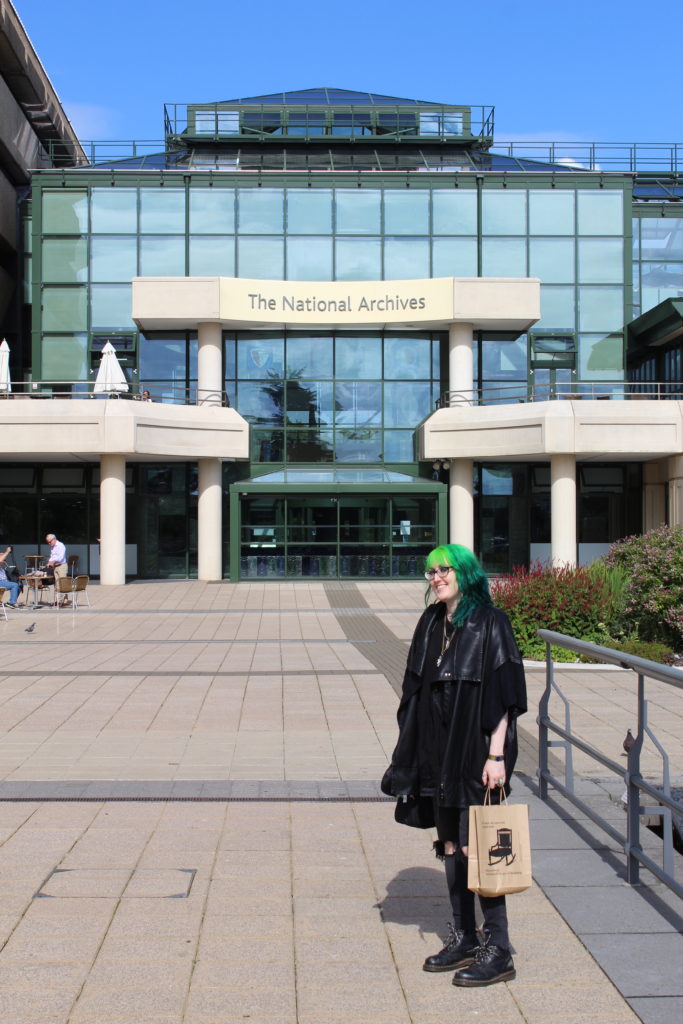
Why, yes, I did go spending money in the UK National Archives bookshop. How did you guess?
You’ll probably find that the most useful archives for your research are in and around where your subject/s lived. Which seems obvious, right? Of course an archive like, say, the Tameside Local Studies & Archive Centre, would focus on people, history and records from Tameside. But many archives also have special collections of certain types of records, some of which come from outside their local area. And there are also special-interest and private archives that have records from all over the place. It pays to keep notes of where you find things, as you’ll start to notice patterns in the types of records that different archives keep.
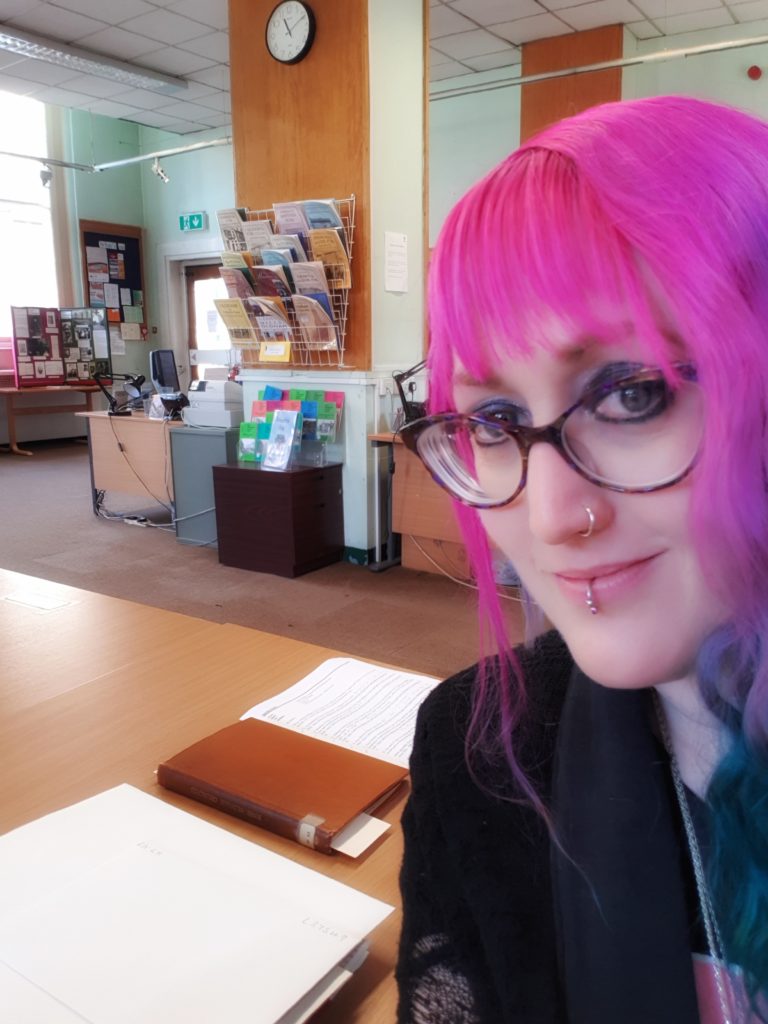
Blurry archive selfie at Oldham Local Studies and Archives. If I look a tad sleep-deprived, it’s because I’d flown in from Sydney the day before and had only had 10 hours sleep in the past four days 😴
4. Know your registration districts (and how they’ve changed over time)
In the UK, registration districts are administrative regions made up of smaller towns and villages. UK birth, marriage and death certificates are held by the record offices responsible for the registration district in which the event took place. Straightforward, right? Yeah, except registration districts have changed a lot over the years. Boundaries have shifted, new districts have been created and old ones have merged. And some towns even have the cheek to straddle two districts, as if they’re going out of their way to make our lives harder 🙄
But help is at hand! The UK BMD website lists all the registration districts for England (1837 to present) and Wales (1837 to 1996). This is a lifesaver for BMD searches and handy to know for other types of archival research as well (because shifting boundaries and administrative groupings influence the focus of other collections too).
5. Go beyond BMDs
Birth, marriage and death records are the bread and butter (or, in my case, Vita-Wheets and hummus) of family history research. But if you really want to know what your ancestors were up to, you have to go beyond BMDs. Census records are the first step, and you’re going to love them. Historically, UK censuses were performed every ten years and their entries are like snapshots of whole families. The details will depend on the year, but they usually contain the names, ages, professions, and birthplaces of every person in the household. This info is invaluable for confirming details found in other records or for picking between two close matches. Your Great-Great-Great Aunt Jane’s job or birthplace could be the final detail that helps you figure out which record belongs to her (and not some other Jane Smith).
There are heaps of different kinds of records out there, and many are free online or available through sites like Ancestry and FindMyPast. There are rate books, which you can use to trace your ancestor’s address between censuses and find out if they owned or rented property. There are tax records, which you can use to find out if your ancestor kept servants, was a gamekeeper, or even used hair powder (seriously). There are migration records, which can tell you when/how your ancestor emigrated, institutional records that can tell you where they worked or studied, and military records that can tell you if they served.
While there are millions of records online, there are even more out there that aren’t. If you can’t find what you’re looking for, try the local history centre or society for your ancestor’s town. There’s no guarantee they’ll have what you’re looking for, but they should have a good idea of where (and if) that type of record is kept today.

Microfilm! So much good stuff at the Lancashire Archives.
6. Join local history societies
The UK has hundreds of local history societies and they’re great! They often have their own (small) archives, with collections that are rarely available elsewhere, as well as online forums full of local history experts. Memberships are usually pretty cheap (like, £14 a year) and they’re one of the best ways to connect with people who share your interests and can help with your research. And who knows? You might even find a long-lost relative.
7. Keep a record of where you’ve looked
With archival research, it’s easy to go around in circles. There’s no end of items you can look for, using thousands of catalogues and an infinite number of search terms. Which is why, for the sake of your time and sanity, you’ve got to keep a record of every search you do. It can be as detailed or as simple as you like, so long as you at least note where you looked, the words (and spellings) you used, and what, if anything, you found. In the past, I’ve used an Excel spreadsheet – you can download and use my template here. But these days, I mostly stick to Trello. Trello is like an online pin board, which you can also share with other people. You can create up to ten boards for free (score!) and I love keeping my notes online so I can access them from any computer or device.
Before you ask – no, I’m not a spokesperson for Trello. I just frigging love it 😜
8. Do background reading and check the bibliographies
I read a lot. And most of what I read these days – fiction and non-fiction – is about or from the time period I’m researching. It’s essential background knowledge that gives context to the raw information I find in records. This helps me understand the world my subjects lived in and the decisions they made.
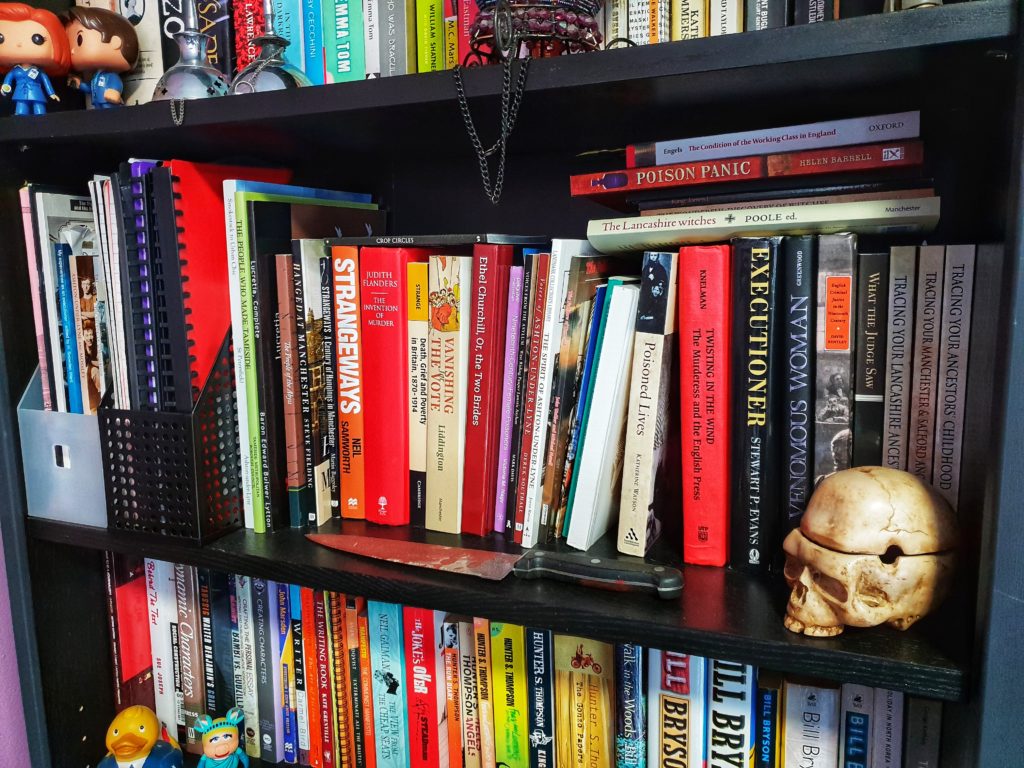
Just some of my Mary Ann Britland, female poisoner and Lancashire-related books. Yes, those witch ones are relevant.
But reading also helps me find records! Knowing the history of a person or place can help me figure out where an item or document might have ended up. And if a book references a document I need (or one that’s similar to it), the bibliography will tell me exactly where it’s located. Brilliant 😎
Want more research tips and Mary Ann Britland titbits? Subscribe to this blog to get new posts straight to your inbox.
APRIL/MAY WRITING UPDATE: Wrote first drafts of two chapters, rewrote another two chapters and edited the introduction. Busy, busy!
CASSIE IS LISTENING TO: Our Fake History, aka my new favourite podcast. Which maybe isn’t a huge compliment given that I’ve only just started listening to them (yeah, I know. I’m old and late to the party). But I stand by this recommendation! Our Fake History is “an award-winning podcast about myths people think are history and history that might be hidden in myths”. It explores some of the most famous stories (and conspiracy theories) from history, including how Napoleon shot the nose off the Great Sphinx (didn’t happen), how Shakespeare was an illiterate fraud (nope), and how Queen Elizabeth was actually a man (total bullshit). The stories are brilliant, but I also love the breakdown of the research and the interrogation of the sources (including which ones you can trust, which ones you shouldn’t, and why). Definitely check it out!


Recent Comments