Sorry for the radio silence, guys. I have a couple of blog posts in process, but have been so flat-out I haven’t had time to finish them. The last couple of months have been crazy with work, travel, and, of course, researching and writing about Mary Ann Britland. I guess it’s true what they say: time flies when you’re having fun investigating 130-year-old murders.
Another thing that’s keeping me busy is preparing for my upcoming combined research trip and holiday, which I’m calling a researchiday. Mostly because it’s fun to say. Try it – I guarantee it’ll perk you up.
This time next week, I’ll be on my way to the UK for three weeks of museums, archives, cemeteries, witchcraft sites, and prisons (as well as the usual eating, drinking, and shopping). I’m visiting London, Manchester, and Edinburgh, and while I do have a few serious research to-dos on my itinerary, my focus will be on spending quality time in the places I’m writing about. Time and place are so important to this story. As a writer, I’m driven by the question of WHY the Britland case turned out the way it did – why Elizabeth Hannah Britland, Thomas Britland, and Mary Dixon died, and why Mary Ann Britland’s life ended with a snap at the end of a 7ft rope. The time and place that these events occurred answer many of those questions, so as a writer I need to make them real for my readers. And the easiest (not to mention most fun) way for me to achieve that is to spend time in those places – which bear their history like scars – and make them real for myself.
Aaand I’m also a travel writer. So making places feel real is kinda part of my job 😜
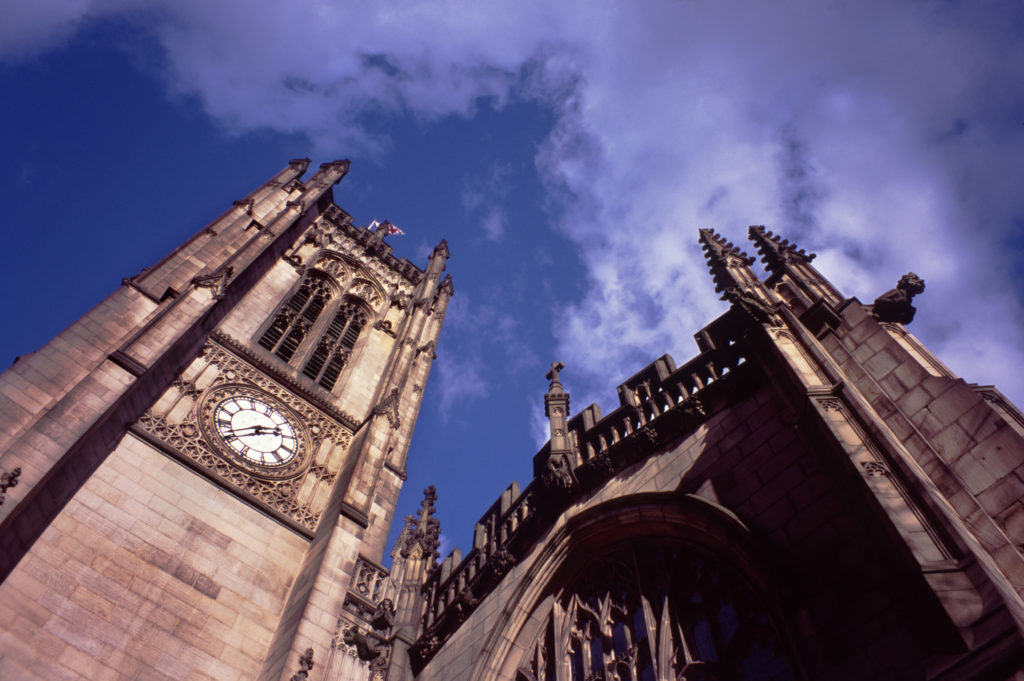
Manchester: Soon I will be in you. Photo credit – http://www.photoeverywhere.co.uk
But enough of my travel plans. I also want to share a cool lead I discovered last week. It’s a neat footnote to the Mary Ann Britland story and a chance to chat about some awesome feminist and Mancunian history.
I’ve been trying to nail down exactly what happened to Mary Ann’s Britland’s youngest daughter, Susannah Britland. Susannah was the only member of the family to survive the events of March – August 1886 (and you thought your 2016 and 2017 were bad). I knew she married a man named James Higginbottom Whitworth in 1896 and that he died in 1906, leaving Susannah widowed and without children. But anything beyond that was difficult to confirm.
The problem was the 1911 census. I couldn’t find my Susannah Whitworth (or Susannah Britland) anywhere, which implied that she had died. But I couldn’t find a death certificate or burial registration that made sense for her either. The only one that did was for a Susannah Whitworth who died in 1932. The name, age, and place were all right, but it’s not uncommon to find two (or more) people of the same name and age living in the same town. To confirm that you’re looking at the right person, you really want some extra info – a home address or an occupation, both of which are included on census forms and death certificates. When you’re trying to create a linear timeline of a person’s life, each new record you find both builds upon and confirms what you’ve found previously. A gap of 31 years between records (remember – census info is sealed for 100 years, so the 1921 records aren’t available yet) is not ideal.
I wondered: If Susannah Britland was still alive in 1911, why can’t I find her in the census? Has her form gone missing or not been digitised? Was she travelling or somehow got missed? I Googled “missing from census” (because Google knows all) and found this awesome post on the National Archives blog. It confirmed that, yes, Susannah’s page might have gone missing or she might have been travelling abroad. But it also raised the possibility that Susannah Britland might have intentionally excluded herself. In 1911, tens of thousands of women boycotted the census as part of the suffrage movement. They protested in London with a late-night picnic in Wimbledon Common, complete with roast fowl, sweetmeats, tea, and placards that read, “If women don’t count, neither shall they be counted”. In Edinburgh, they met in cafes and hid in barns and hay lofts. And in Manchester, many hid in a grand old house temporarily renamed the “Census Lodge”. They blacked out the windows, covered the floors in mattresses and thin blankets, and slept huddled together beneath signs that declared: NO VOTE, NO CENSUS. Check it out:
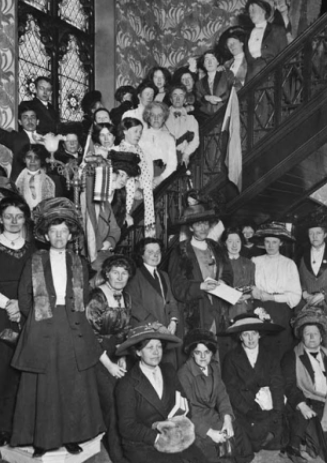
Census Lodge – from ‘Vanishing for the Vote: Suffrage, Citizenship and the Battle for the Census’ by Jill Liddington
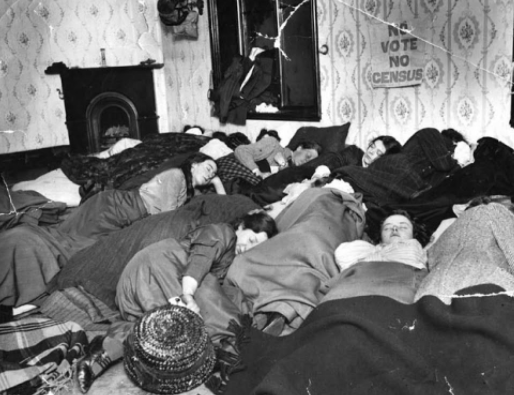
Census Lodge – from ‘Vanishing for the Vote: Suffrage, Citizenship and the Battle for the Census’ by Jill Liddington
Was Susannah Britland a suffragette? As a young, working-class widow in Manchester (a city famous for its radical history. Emmeline Pankhurst founded the Women’s Social and Political Union there in 1903, just one year after female textile workers from Northern England sent a petition to Parliament demanding votes for women. They had collected 37,000 signatures), she seems a likely candidate. With no husband or family to support her, Susannah Britland was completely on her own. The fact that she was entirely responsible for her own survival (while almost certainly being paid less than any man she knew, even those in similar jobs), yet still not permitted to vote for her own interests could not have escaped her notice. Ironically, the fact that she did not have a husband to support her (and, in turn, answer to) may have also given her more freedom to participate in the suffrage movement and take part in protests like the boycott. Many husbands dobbed in their census-dodging wives, like this one here.
It’s an intriguing possibility, and one that makes sense with the evidence I’ve found and within the historical and cultural context I’m working in. But I haven’t confirmed it yet. That will take even more research. It might have to wait until after I get back from my trip 😜
Want to keep following the story? “Like” my Facebook page or follow @CassieBritland on Twitter.


Recent Comments