I love words. I’m not an expert in them and I can only speak one language, which is really lame, because I find words – their origins, their meanings and the way those meanings change over time – so fascinating. As an adult, I curse High School Me for not sticking with any of the languages I started in school.
And when I say I only speak one language, what I really mean is I only speak one version of one language: General Australian English, one of the dozens of English dialects spoken around the world (this writer counts 160, but I’m sure there could be more).
So with my amateur word nerdery, it’s probably no surprise that one of my favourite parts of researching Mary Ann Britland’s life is all the brilliant new Manchester, Lancashire and 19th-century words I’m learning. Here’s a collection of some of my favourites. See if you can slip one into your next conversation.
Heads-up: As I’ve already said, I am most definitely NOT an expert. Most of these words and definitions come from Sounds Gradely: A Collection of Dialect and Other Words Used in Lancashire Folk Speech, edited by Ken Howarth. If you think any of them are mistaken or if you’ve heard other definitions, leave me a comment!
BLEB
A small blister (Mawdesley, Sabden, Garstang, Preston).
Cute word, but blebs suck! Especially when you get them on your tongue because you’re impatient and eat food while it’s still way too hot… Not that I’ve ever done that.
BLOB
A jellyfish (Lytham, Marshside).
I love this for its simplicity. Jellyfish are blobs. Why do we bother calling them anything else?
See also: Cabbage blob – a very large jellyfish (Fleetwood).
BOGGART
a). A mischievous imp-like figure (Rossendale, Sabden)
b). An evil spirit (Leigh, Hapton, Rochdale, Garstang, Eccleston, Burnley)
c). A ghost (Towneley Colliery, Burnley)
Legend has it these little ghost-goblin jerks plague England, souring milk, wilting crops, stealing household items and abducting children. Once they attach themselves to a family, they follow (and pester) them forever. Total jags.
BREECHES/BRITCHES-ARSE STEAM
To work hard; a job requiring requiring great physical effort (Agecroft Colliery, Outwood Colliery, Haydock, Blackburn, Accrington, Rossendale).
I love this! I’ve only found a few examples of it in use online, but “breeches-arse steam” seems to be used like “elbow grease”. For example, “I’ll fix my broken bathroom pipe myself with a hammer and some breeches-arse steam” (note: this example is a lie; I absolutely will not be doing that).
It’s fitting this expression should trace back to coal mines and their communities. Coal mines are notoriously hot, cramped places to work and miners traditionally wore breeches (even if they were female – scandal!). I wonder if “breeches-arse steam” is the over-achieving linguistic cousin of “half-arsed”?
CHOKEY
Bread and water, as served in prison (Strangeways Prison).
An appetising name for what I’m sure is an appetising dish… 😬
CHOOSE-HOW
a). Whatever; nevertheless (Rawtenstall, Rochdale)
b). Like it or not (North England)
c). Used at the end of a sentence to add emphasis (Devon)
This is an interesting one! I initially added it to the list because it reminded me of “Yeah, nah” (meaning “No”) and “Nah , yeah” (meaning “Yes”) in Australian English, but I found two more definitions (b and c above) when I tried to find an example of it being used online. The only example I found was written by a woman from Devon, who said it was used to add emphasis. Her example was “That’s a terrible tall hill, choose how”, which she defined as “That’s an extremely tall hill”. If this is a term you grew up with, I’d love to hear your definition or an example 😊
CHRIMBO
Christmas (Burnley).
This has definitely spread beyond Lancashire (if, indeed, that is where it was first used). Chrimbo is the new Xmas.

Chrimbo lights in Manchester. Pic by Rachel Docherty.
CLEM
Extreme hunger; to starve (Tyldesley, Mawdesley, Sabden, Over Wyre, Melling, Wigan, Rochdale, Stalybridge, Wiswell, Ormskirk, Eccleston, Clitheroe, Westhoughton, Hollinwood, Burnley, Leigh).
“Clem”, “clemming” and “clemmed” were in common usage all over Greater Manchester and Lancashire… because people clemmed to death all over Greater Manchester and Lancashire. Check out Mary Barton – Elizabeth Gaskell’s fictional-but-all-too-true account of life in 1840s Manchester – for many examples (and some solid gothic melodrama).
DEXIE
a). A young, mischievous boy (Mawdesley).
b). The devil (Preston).
Looks like Dexie’s reputation precedes him… 😈😈😈
DICKS
Head lice (Hyndburn).
Good news, parents! You’ve now got a semi-valid excuse to call your child a dickhead. But it still probably won’t go down well.
DOLLYMOP
A part-time prostitute (Britain, 19th century).
‘Dollymop’ is a really sweet-sounding term for what was meant to be a terrible insult. ‘Dolly’ was a 19th-century slang term for penis but I haven’t found any clear explanation for the ‘mop’ part. Could it be the association of ‘mops’ with domestic servants (as seen in events like ‘mop fairs‘) and the (tenuous and less-than-consistent) association of domestic service with sex work? I don’t know, but I’d love to hear from anyone who does.
ECKY THUMP
An exclamation of surprise (Bolton).
So the White Stripes didn’t just make it up! Apparently Bill Oddie used to say ‘ecky thump’ a lot in The Goodies, which I don’t remember at all (probably because I was in preschool). All I remember is the giant kitten…
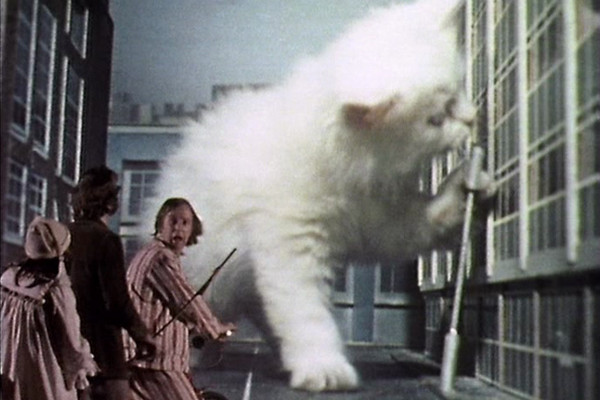
All hail Kitten Kong! Pic from IMDb.
GIVE UP TAKING SUGAR
To be dead (Accrington).
Yeah, I guess you would. But you’d give up other stuff too. What’s so special about sugar?
GOFF
An ignorant, stupid person (Mawdesley).
Um, harsh. I don’t make fun of your subculture, Mawdesley 🦇
Seriously though, I don’t know the origin of this one and I couldn’t find any examples of its use online. Has anyone ever heard it used?
LEAPERS
Human fleas (Strangeways Prison)
I’m disturbed but not surprised that Strangeways has its own slang for fleas (and that it distinguishes human fleas from animal ones 😟).
LOLLIGOT
Tongue (Lancaster).
I’m not sure if I think ‘lolligot’ sounds cute or gross. Maybe both? I couldn’t find any examples of it in use online either, which is a shame because I really want to confirm Sounds Gradely‘s definition so I can start slipping it into casual conversation (you know, my casual conversations about tongues).
MARMALISE
Combination word. To murder and paralyse; to hurt (Liverpool).
This one sounds like a tautology. I’m pretty sure that someone who’s been murdered will also be paralysed – they’re not likely to do much walking. But I still like the word, at least partly because it reminds me of marmalade.
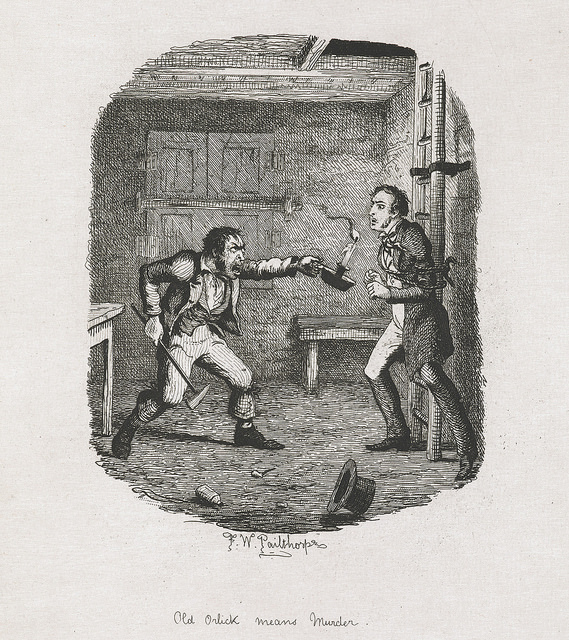
Attempted marmalisation in action. Pic from the British Library.
MORBS
A sad or depressive mood (Britain, 19th century).
This one’s been doing the rounds online for awhile now, but I don’t care. Leaving it out would have given me the morbs.
MULLIGRUBS
To be in ill humour; to have the mulligrubs (Cheshire).
Aha! As an Australian child of the ’80s and ’90s, I totally get this. The Mulligrubs TV show was a nightmare and it only makes sense that it was born of misery and despair. F*$&ing Mulligrubs.
NADGERS
Testicles (or genitals in general). Also nadge – to copulate (Hindley).
*Insert juvenile snickering here*
PISS-A-BEDS
Dandelion flowers (throughout Britain).
This one made it to Australia too. The name comes from the folk belief that if you pick or play with dandelions, you’ll wet the bed. Like much of folklore, there’s some truth to it; dandelion roots are a powerful diuretic and were used for thousands of years to treat inflammation, swollen lymph nodes, cysts and abscesses, as well kidney and liver complaints. Just don’t take them before bedtime.
There are other variations around the world. The French word for dandelion is ‘pissenlit’ (from the French for ‘piss the bed’ – ‘pisser le lit’), while in some Northeastern Italian dialects they’re known as ‘pisacans’ (from the Italian for ‘dog pisses’ – ‘cane piscia’).
PUKKA
Genuine (Everton).
So now I know what Pukka Tukka means. But I’m still not going to watch it.
SKIDADDLE
To clear off; run away (Radcliffe, Mawdesley, Bacup, Preston).
I use this a lot (although the Macquarie Dictionary’s preferred Australian spelling is ‘skedaddle’) and now I’m wondering where I first picked it up. Did I read it? Steal it from an older relative? Wherever I found it, ‘skidaddle’ was impossible to resist. It’s just too much fun to say.
There’s a US variant too: ‘Skiddoo’. But I’m all about that ‘daddle.
SLUT
A quarter pound of black tripe (Ashton-under-Lyne Market).
I’m going to go out on a limb and say you probably shouldn’t try to order a slut from the market today. For a decent tripe dish, you’d need at least four sluts anyway.
STEPMOTHER’S BLESSING
Jagged, split, raw or loose skin at the base or side of a fingernail. Also known as stepmother’s jags (Radcliffe, Accrington, Garstang, Preston, Leylannd, Haslingden).
I know these jerks all too well…
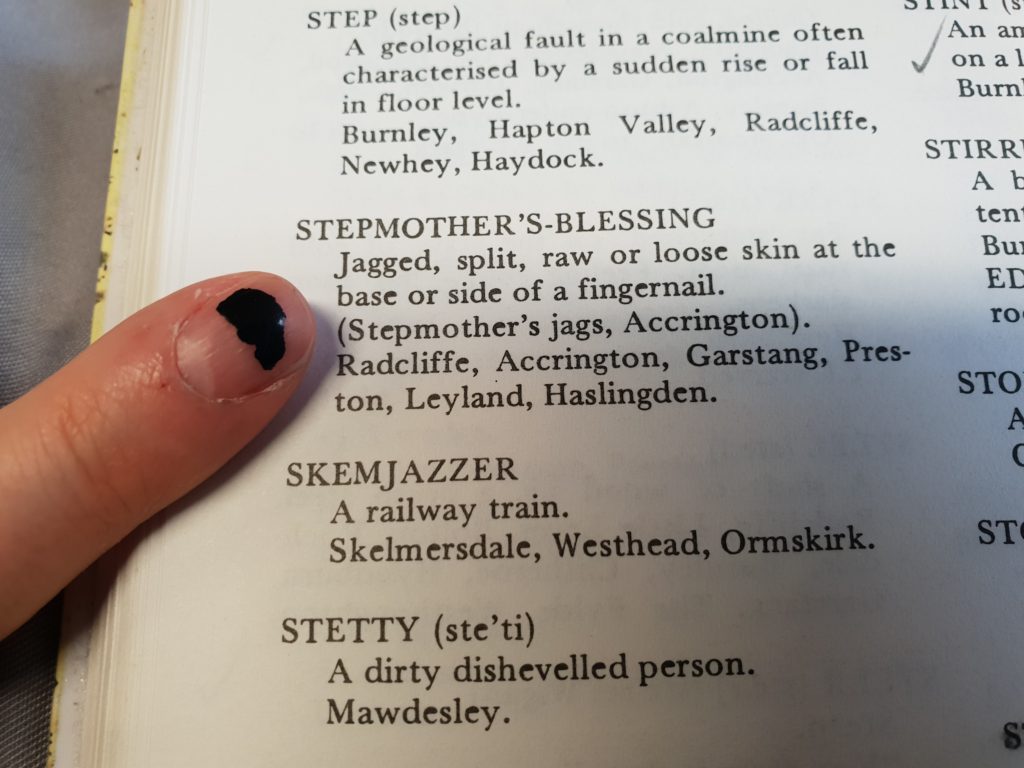
Chilly Manchester “summers” are not kind to my skin…
TH’OWD LAD
The Devil (Preston).
I like to imagine this is the Satanic equivalent of Australian English’s “old mate”. I also love how many names we have for the Devil.
TOPPING SHED
The building where hangings were performed at Strangeways Prison (Strangeways Prison).
This is sadly accurate. Strangeways Prison had a permanent gallows which, for many years, was indeed inside a shed. It was replaced with a specially built execution chamber after the First World War.
Know any good Manchester, Lancashire, or Victorian words I’ve forgotten? Tell me in the comments!
MARCH WRITING UPDATE: Wrote and submitted three articles for an upcoming anthology (watch this space). Finished the first draft of another chapter – woohoo!
CASSIE IS READING: The Victorian House by Judith Flanders (2003). Flanders uses the model Victorian home to explore the rules, routines and (impossible) ideals of Victorian domestic life. Each chapter focuses on a different life stage or experience, as it was lived in the room/s designated for that purpose. It’s more London and middle-class focused than I was hoping for (an intentional decision by Flanders that I’m not criticising), but it’s still a great insight into the standards that Victorians of all classes aspired to. If you’ve ever walked through an old house and honestly said, “If these walls could talk,” this is the book for you.


I always presumed that ‘Chrimbo’ came from Australia – it fits the Aussie shortening pattern.
Chrimbo does sound very Australian, doesn’t it? We love shortening words and adding random Os. I can’t find anything other than Sounds Gradely to back up the Burnley origin, but apparently it’s been use in the UK since the 1920s.
I’ll just skidaddle off to bed now. Great word much better than f—-loff. Don’t you think? Enjoy the read.
Definitely much more friendly! I’m glad you liked the post 🙂
My mother use to love tripe!! Wonder how many sluts she ate in her lifetime?!?
Ha! I have no idea but I suspect she wouldn’t have appreciated this comment 😉