Wow, two months between posts! That’s bad, even by my standards.
Sorry (again) for the radio silence (again). I’ve been flat-out travelling for work (and play), trying to stick to my self-imposed deadlines (I’m currently three weeks behind), writing some extra stuff for a cool secret side project (more on that early next year), and using too many parentheses (like these). It’s a lot to keep up with!
I’ve made some interesting research discoveries, but I’m not sure how much I want to share at this point – I don’t want to give away my own spoilers. So here’s a quickie photo post so you know I’m still doing *something*. Enjoy!
But first – a massive shout-out to my Manchester hosts, tour guides, and research gurus, Emma and Clancy. Much of what I now know about Manchester’s architecture and geography is thanks to them. Anything I’m mistaken on is probably all me ;P
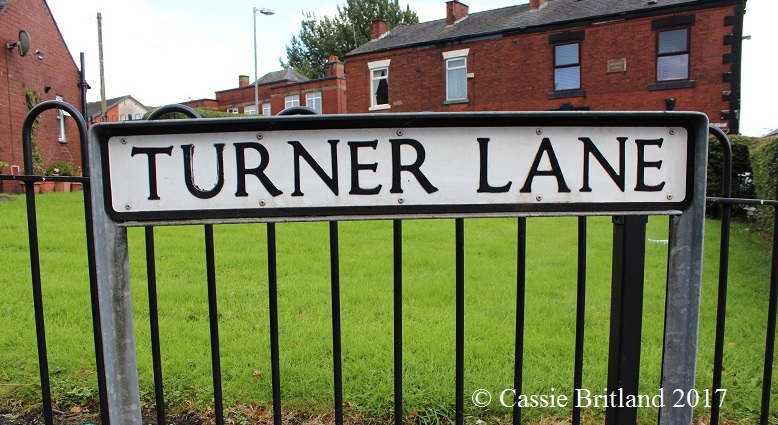
Here it is – Turner Lane, Ashton-under-Lyne. The literal scene of the crime. This is the street where the Britlands and the Dixons lived, and where Elizabeth Britland, Thomas Britland, and Mary Dixon were murdered.
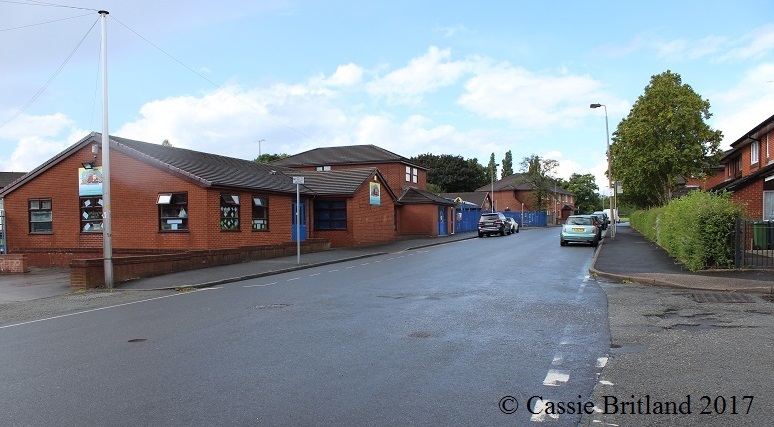
This is what Turner Lane looks like today. There used to be a row of old back-to-back terraces on each side of the street, but now almost all of them (including the one Mary Ann Britland lived in) are gone. Mary Ann Britland’s house probably stood where that blue fence is. I don’t have a full-frontal shot of that plot, though. It’s now a childcare centre, with a playground just behind the fence. Not an appropriate place for a stranger to stand around taking photos :S
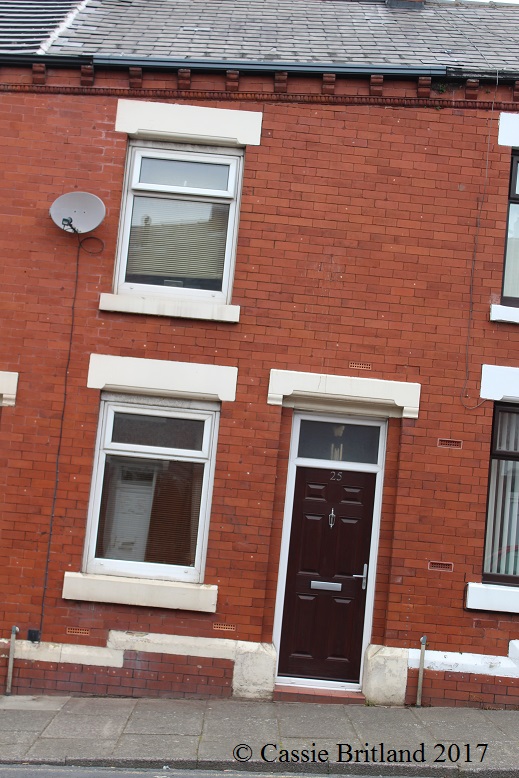
Snapped this pic a few streets away. This is pretty close to what Mary Ann Britland’s house would have looked like (minus the satellite dish). A two-up, two-down back-to-back with one window in each room. ‘Two-up, two-down’ refers to the house’s layout – two rooms upstairs (both bedrooms), and two rooms downstairs (a sitting room at the front – usually reserved for company or sometimes rented out to bring in a little extra money – and a kitchen at the back). Outside the kitchen was a small courtyard with a privy.
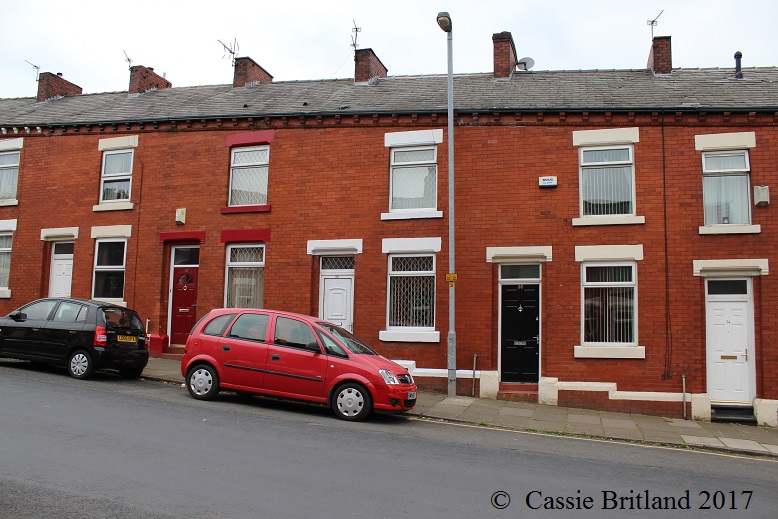
Here’s a whole row of them. These terraces were quickly and cheaply built to accommodate Manchester’s mill workers, whose numbers grew as rural Victorians left the countryside to find work in the city.
Note how the doors and windows are squared off. Most of the remaining back-to-backs in this area have arched brickwork over the front door or some other slight bit of ornamentation, but not these houses. They appear to have been the most basic of the basic. This could explain why there are so few of them left – they simply weren’t worth the effort or the money to maintain or restore.
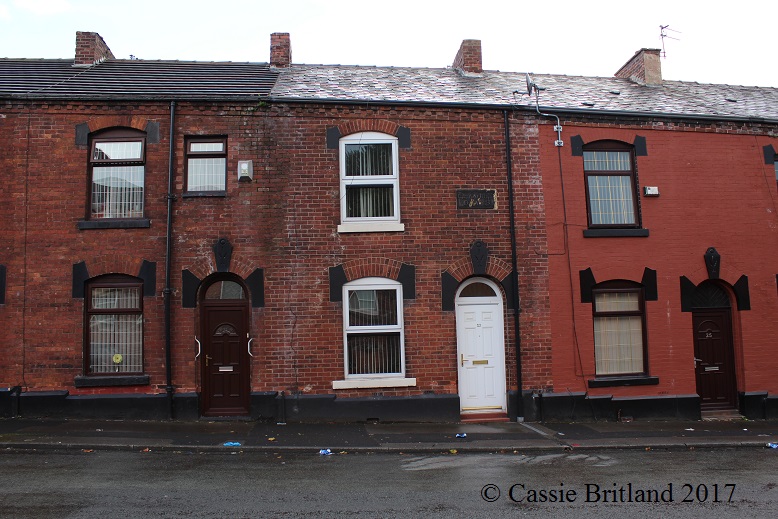
Here’s a comparison. See how the doors and windows have arched brickwork and a little bit of plasterwork? The terraces even look a bit wider. The black plaque on the middle terrace says ‘1876’ – that’s probably the year these houses were built, which means they went up around the same time as the plainer, narrower houses in Turner Lane. These differences weren’t due to changes in building techniques or materials – they were due to time and money spent. These houses were meant for a slightly better class of Ashtonian.
(Digression: A couple of months ago, I saw a terrace like one of these, probably just a few streets away, for sale for £70,000. In Sydney that will buy you a literal shoe box, which you can store a toothbrush in as you move from friend’s couch to friend’s couch. Sydney is the worst.)
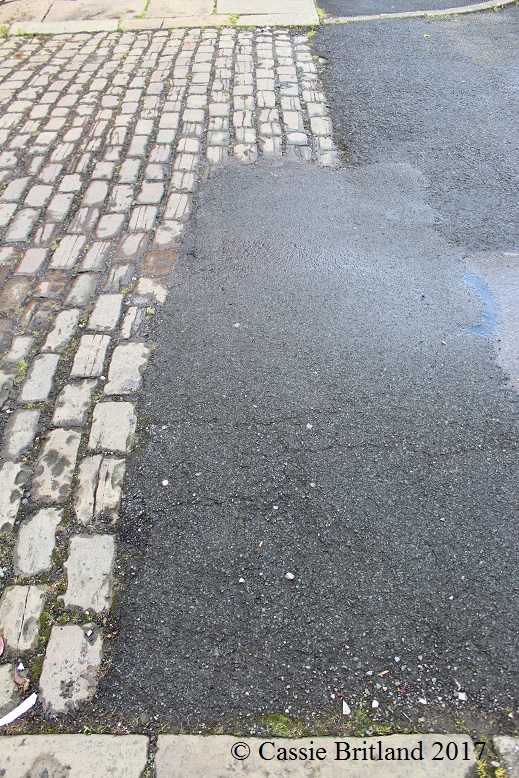
Bitumen over cobblestones. One of the coolest things about Manchester is the way it keeps building on top of itself, never completely demolishing or burying its history. You see structures in three parts – a building or wall with a medieval foundation, a Victorian middle (built out of medieval rubble), then a post-war top (usually in mock-Victorian style, ’cause screw that modern stuff). I imagine these architectural mash-ups are relics (see what I did there?) of Manchester’s working-class past – a byproduct of having to expand and rebuild on the cheap. I hope they won’t end with current (tidal) wave of gentrification that’s sweeping the city.
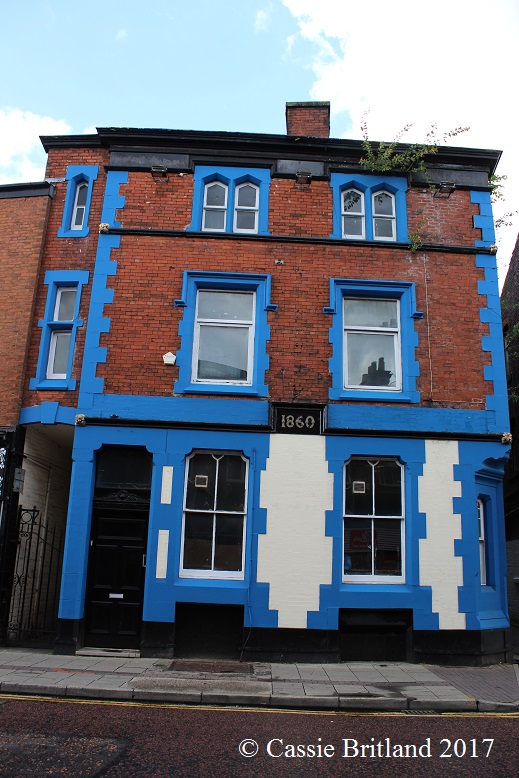
This is Heap’s Vaults, the pub where Thomas Britland used to work. A pub has been on the site since at least 1791, although it was probably rebuilt or substantially altered in 1860 (hence the plaque). In 1900, the name changed to Ye Olde Vaults (the name by which it’s now most commonly referred), although it most recently operated under the name Chambers. But you can probably call it whatever you like – it’s been closed since at least 2011.
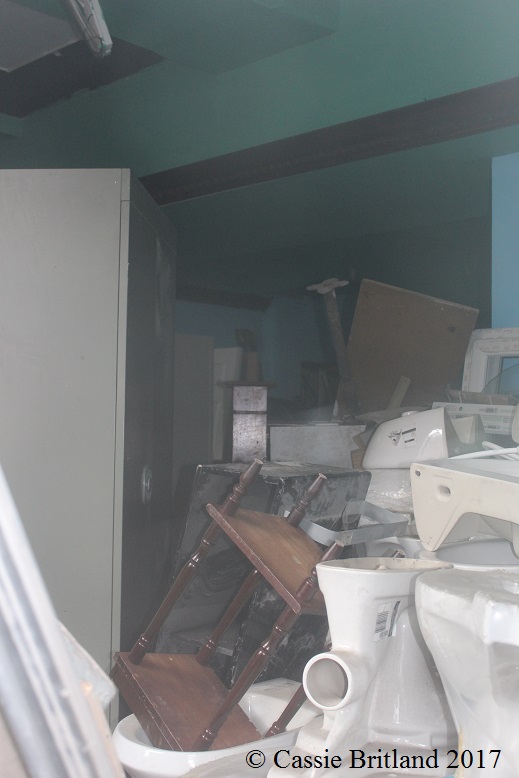
Inside Heap’s Vaults. The windows were actually up quite high, so I wasn’t tall enough to stickybeak inside. So I held my camera up and snapped a pic. It was the world’s less practical periscope.
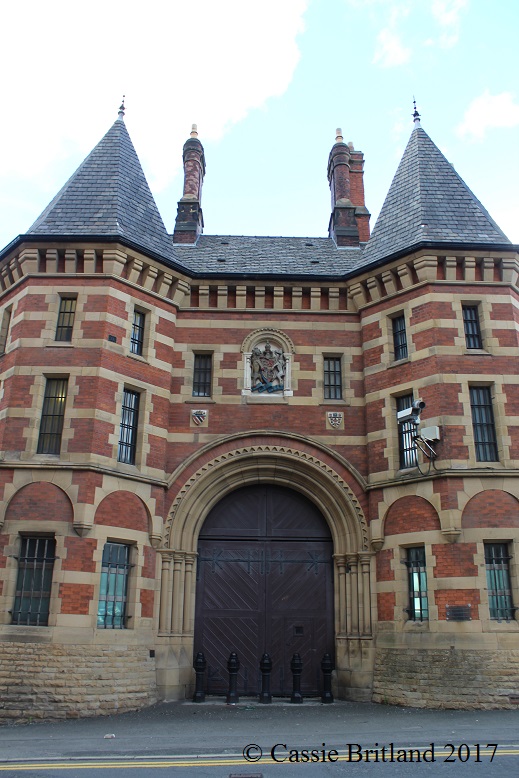
Strangeways Prison! Mary Ann Britland was taken to Strangeways immediately after her arrest and stayed there throughout her inquest and criminal trial. Once convicted, she was taken to the condemned cell in the basement of the B wing, in the men’s section of the jail. Just across the corridor from the condemned cell were a set of double doors that opened into the execution shed, where Mary Ann Britland made history as the first woman executed at Strangeways. For two-and-a-half weeks, she ate, slept, prayed, and wept just metres from where she was sentenced to die.
This picture shows the old Victorian gate, which Mary Ann Britland was taken through when she first arrived at the prison. Crowds gathered here the day she was hanged and an execution notice was nailed to the door.
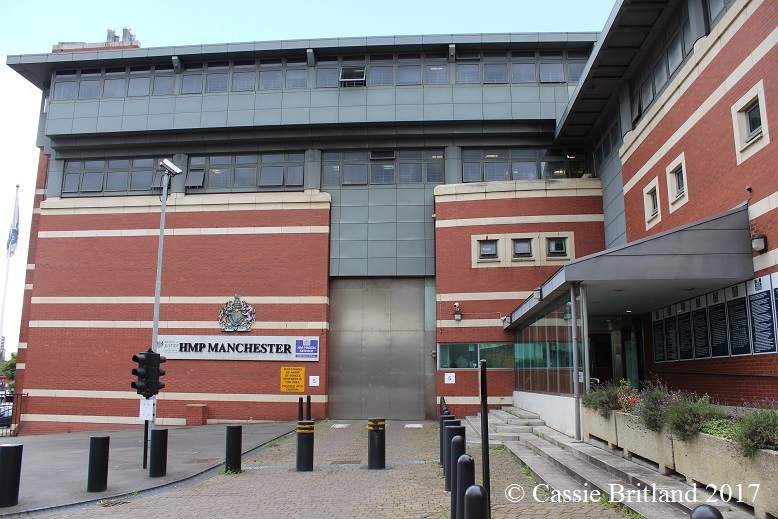
This is the new entrance. Strangeways is now officially called HM Prison Manchester, although most people still know it as Strangeways. Most of the prison was rebuilt in 1990, after a massive riot in which much of the old prison was burnt down.
HM Prison Manchester is still an active maximum security prison, and the fact that we could walk right up to it – hell, hang around the front gate and take photos – blew my mind. At one point, a van pulled up to that big steel door, which opened to reveal a loading dock. I went to take a picture when two guards came out of the office on the right, heading straight for me. One pointed at me and shouted, “Hey!” and I almost died. “This is it,” I thought. “This is me, getting arrested.” But no. The guard’s full sentence, as he pointed behind me, was, “Hey! Look at that lightning!”
Manchester, I love how you DGAF. Not about weirdos taking photos of prisons, that is. But a decent crack of lightning gets you super pumped.
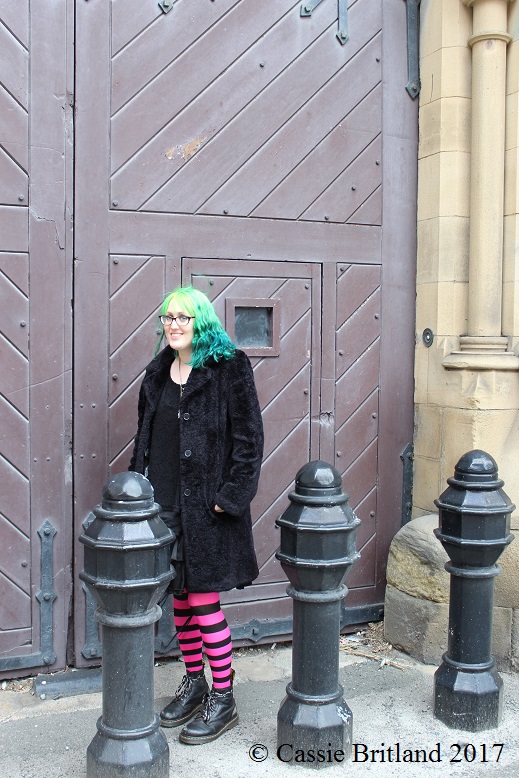
And here’s me, looking derky. Derky? I guess that’s a cross between derpy and dorky, which is about right. But that’s fine. I made it to all the way from Sydney to Strangeways without getting arrested. That’s good enough for me.
Psst. Like this post? Want to know when I finally finish this book? Follow my Facebook page or Twitter for regular updates.


That Bitumen over cobblestones photo makes me sad.
It’s kind of poignant, isn’t it? 130 years after these people died and almost nothing of their world remains. If it weren’t for their connection to a horrible crime, it’d be as if they didn’t exist 🙁